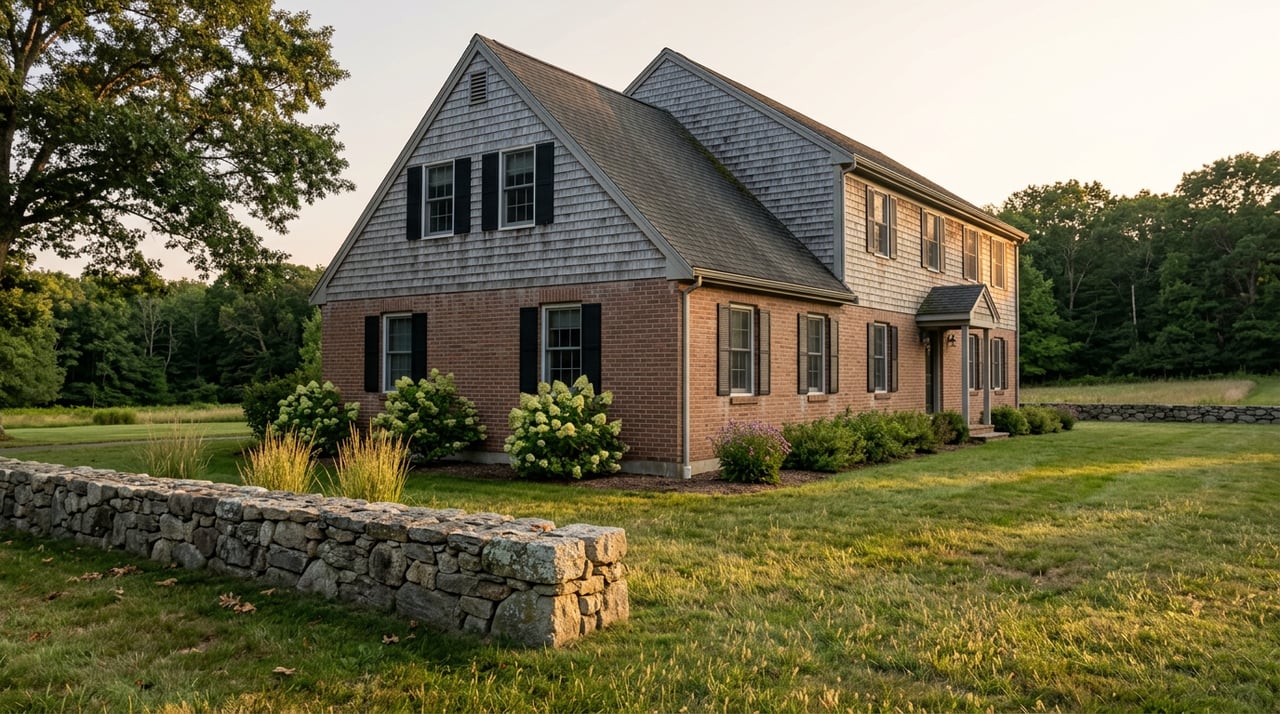
A buyer falls for a Cape on a quiet Hadley road, the kind with a hayfield rolling out behind the back fence and nothing but tree line beyond it. The listing agent mentions, almost as a selling point, that the field abuts land under an Agricultural Preservation Restriction. The buyer hears "protected" and pictures the view frozen exactly as it is: mowed grass, maybe a tractor passing twice a summer, silence otherwise. Then somewhere near the closing table, a page appears that nobody mentioned during showings. It is Hadley's Right-to-Farm disclosure, and it says something closer to the opposite of what the buyer assumed.
That disclosure exists because "protected" and "quiet" are not the same promise. In Hadley, they are frequently not even related.
What the APR Actually Buys
An Agricultural Preservation Restriction is a real estate transaction in its own right. The state, the town, or both pay a farm owner the difference between what the land would be worth if it could be subdivided and built on and what it is worth as farmland alone. In exchange, the owner signs away the development rights permanently. The Massachusetts Department of Agricultural Resources runs the program specifically so farmers can access that equity without having to sell to a builder.
What the APR does not do is freeze the farm's operations. It restricts what can be built on the land, not what can be grown on it, what animals can be raised on it, or what hours the equipment runs. A field of hay today can become an orchard, a vegetable operation, or a livestock pasture tomorrow, and none of that requires a variance or a hearing, because none of it touches the development restriction the APR was written to enforce.
The clearest local proof of that is the Szala farm in North Hadley. Kestrel Land Trust worked with the town and the state to place the Shattuck Road and Comins Road parcels under permanent protection, and the land did not sit still afterward. It was eventually transferred to the Food Bank of Western Massachusetts to become a second Food Bank Farm, operated by local growers producing fresh vegetables for the region. A historic canal on the property is now part of a public trail easement. The land is more protected than ever and it is also actively being used in a way that looks nothing like it did when the deal closed. That is what "protected" is supposed to mean in Hadley: permanent farmland, not a permanent postcard.
What the Disclosure Actually Says
Hadley adopted its Right-to-Farm bylaw specifically to shield working farms from nuisance complaints filed by newer neighbors who assumed rural surroundings meant rural silence. The bylaw states plainly that agricultural activity can occur on any day, at any hour, and that the noise, dust, odor, and fumes that come with normal farming practices are not, by definition, a legal nuisance. The town is required to post a disclosure notifying buyers that the property they are acquiring sits in a community where farming happens and that farming may include exactly those things.
This is not a Hadley quirk invented to scare buyers. It restates protections that already exist under Massachusetts law, including the state's own right-to-farm statute and the constitutional basis for it under Article 97. Hadley's version simply makes the disclosure explicit and puts it in front of the buyer in writing, because the town has more working farmland than any other town in the Pioneer Valley and more reason than most to spell out what that means before someone signs.
Why Hadley Specifically
This isn't background noise for one or two rural listings. As of August 2026, more than a third of Hadley's total land area is permanently protected, a mix of APR farmland and conservation land, and Hadley carries more working farmland than any other town in the Pioneer Valley. That is a genuinely unusual concentration for a town this size, and it means the Right-to-Farm disclosure is not an edge case here. It is a routine page in a routine Hadley closing, especially for anything near the working fields that ring the town center.
The pipeline is still active. In an August 2026 interview with the Daily Hampshire Gazette, new Town Administrator Nate Malloy and Assistant Town Administrator Jennifer Sanders James described three additional farms currently moving through the APR process, mostly independent of Town Hall, with occasional requests for matching funds through the Community Preservation Act. More farmland is being locked into permanent agricultural use right now, in real time, while buyers are touring homes nearby.
The Other Half of the Story
What makes this moment worth understanding, rather than just filing away as a disclosure formality, is what the town is doing at the same time. In that same conversation, Malloy described Hadley's active study of a Chapter 40R smart growth district along the Route 9 corridor, a commercial strip that carries roughly 100,000 cars a day. The goal is infill and mixed-use development that could bring housing and tax revenue into a stretch of town that is already built out, without touching the farmland the town has spent decades protecting.
That is the real shape of Hadley's market right now. The town is drawing a hard line between land that will never be developed again and land it is actively trying to develop more. A buyer who understands this is negotiating from a clearer position than one who only reads "abuts protected farmland" as a scenic bonus. It tells you where you sit relative to two very different futures the town is pursuing on purpose.
What This Means When You're Choosing a Property
The practical version of all this comes down to what a buyer asks and checks before writing an offer, not after.
| Assumption a buyer often makes | What's actually true |
|---|---|
| "Protected farmland" means the view stays exactly as it looks today | APR protects the land from development, not from a change in crop, livestock, or farming intensity |
| The Right-to-Farm disclosure is boilerplate | It restates a real legal shield that limits nuisance claims over noise, dust, and odor from neighboring farms |
| A quiet hayfield now means a quiet hayfield later | Working farms can shift to orchards, dairy, or other operations without a zoning process |
| Land near Route 9 will stay purely commercial | The town is actively studying denser, mixed-use development for that corridor |
Before going under agreement on anything bordering open land in Hadley, it's worth asking a few direct questions: is the abutting parcel actually under APR, enrolled in Chapter 61A for tax purposes, or simply undeveloped for now with no restriction at all? Those are three very different levels of permanence, and a quick check with the Registry of Deeds or the town's Conservation Commission answers it. It's also worth asking what the farm currently grows or raises, since that tells you more about day-to-day life next door than the word "protected" ever will.
A Few Questions Worth Asking Directly
Does the Right-to-Farm disclosure mean I can never complain about a neighboring farm? It means ordinary farming activity, conducted according to generally accepted practices, is not treated as a legal nuisance. Complaints about genuinely negligent or unusual conduct still have a path through the Board of Health or Select Board.
Can a hayfield legally become a livestock operation without any public process? Yes, as long as the change is agricultural use on land already zoned or enrolled for it. The APR restricts development rights, not the type of farming.
How do I find out if a specific property abuts APR land before I make an offer? The Registry of Deeds shows recorded restrictions, and Hadley's Conservation Commission and Agricultural Commission can confirm which nearby parcels are permanently protected versus simply undeveloped today.
Buying near farmland in Hadley is not a reason for hesitation. It's one of the more stable long-term bets in the Pioneer Valley precisely because so much of it can never be built on. The point is going in with the right expectation. Protected means permanent farmland, not a promise about the volume, smell, or shape of the farming itself.
If you're weighing a property near open land in Hadley and want a clear read on what's actually protected, what isn't, and what the disclosure in front of you really covers, Lauren Robertson can walk through it with you before you write an offer, not after. Let's Connect.
